Feature Upvote is a focused feedback board. Players or customers post ideas, vote on them, and see what the team decides. Today its homepage presents it as player feedback boards for game developers, and PLAION is one of the studios it features.
People look for an alternative for two reasons. The price is per board and starts at $49 a month after a 30-day trial, with no free plan. And in Discord, where many game communities already talk, the integration is a notification feed of new suggestions and comments for your team. Players post and vote on the board itself.
A disclosure first. We make Featurevote, one of the tools below. Every price and feature in this post was read on October 10, 2026, on each vendor's own pages, and each one is linked so you can check it yourself.
What does Feature Upvote cost today?
Feature Upvote lists two plans, both priced per board, and an Enterprise plan on request, for needs like more than ten boards.
- Indie is $49 per board a month billed yearly, or $59 billed monthly.
- Standard is $99 per board a month billed yearly, or $119 billed monthly.
- There is a 30-day trial with no credit card and almost all features enabled, and no free plan after it.
- Both plans include unlimited contributors, team members and votes, plus single sign-on, private boards, a custom domain, Jira and Discord integrations, and the option to hide the Feature Upvote branding.
- There is a discount for charities and non-profits.
So the cost question is mostly about boards. One game with one board is $588 a year on Indie. A studio with three games and a board for each pays for three. Feature Upvote's FAQ notes that some customers with similar products run one board with tags. All of this is on the Feature Upvote pricing page.
Players don't need an account to vote. Feature Upvote's help center says anyone can upvote a suggestion or add a comment, and people add a name and email when they post a suggestion.
What should you compare in an alternative?
Four questions sort the field quickly.
- Is there a free plan, or only a trial? A trial ends. A free plan keeps a small board running.
- What does the price count? Boards, admin seats, tracked users or items. Whichever one grows on its own is the one that sets your bill.
- Can people vote without making an account? Feature Upvote allows it, so check that an alternative does too.
- What happens in Discord? Some tools send your team a notification. Others let members suggest and vote from the server.
How do the alternatives compare?
| Tool | Free option | What the price counts | Cheapest paid plan |
|---|---|---|---|
| Feature Upvote | 30-day trial | Boards | $49/board/mo, billed yearly |
| Featurevote | Free plan | Boards, with 15 open requests on free | $9/mo per board, billed yearly |
| Fider | Free plan, or self-host | Feedback items, 250 on free under fair use | $25/mo |
| Featurebase | Free plan | Admin seats, 1 on free | $29/seat/mo, billed yearly |
| Canny | Free plan | Tracked users, 25 on free | $79/mo, billed yearly |
| Nolt | 10-day trial | Boards | $29/mo for 1 board, billed yearly |
Prices and limits read on October 10, 2026, on each vendor's own pricing page. Prices in this category change often, so follow the links before you rely on one.
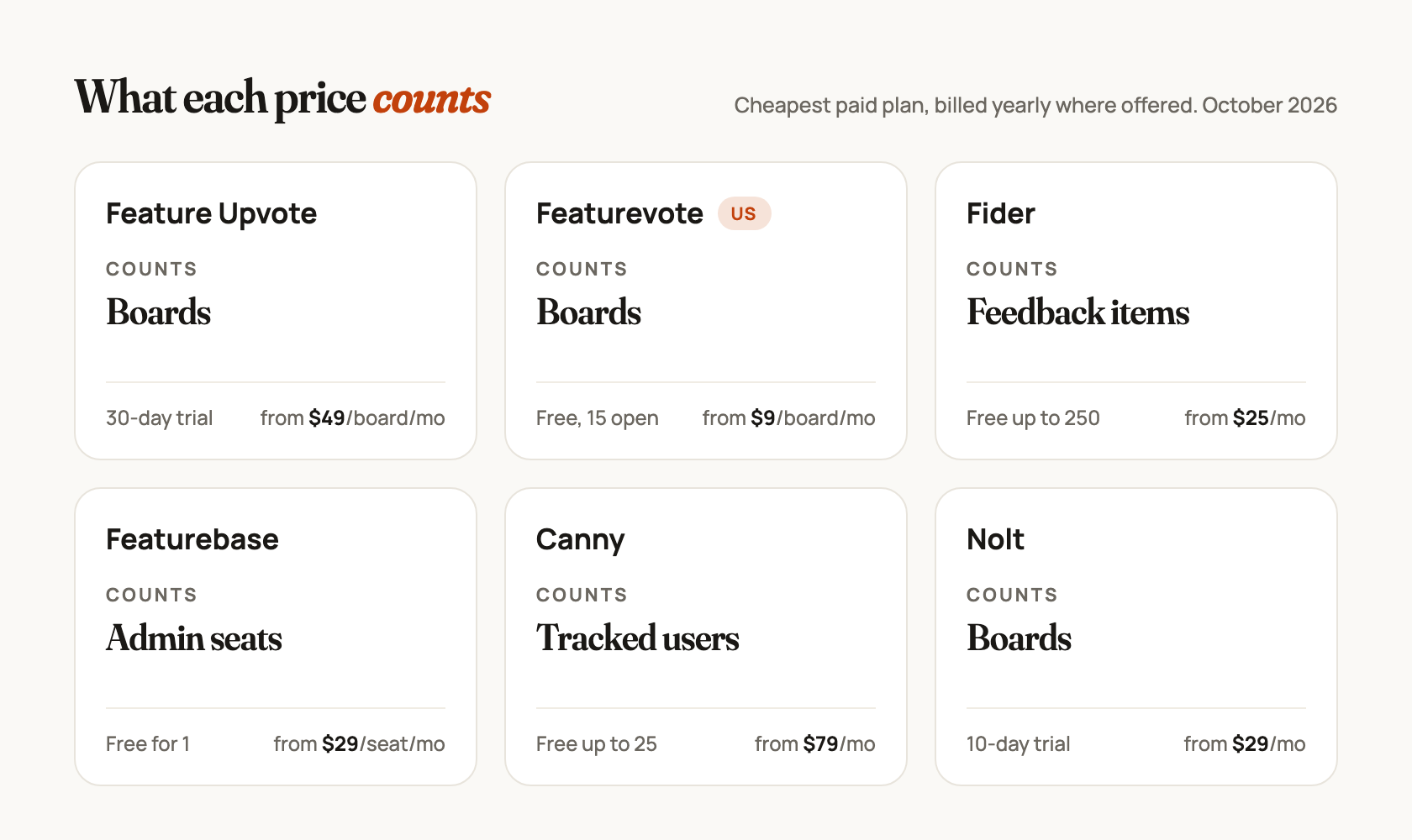
The useful thing to notice is what grows on its own. Players keep arriving, so a price that counts players or voters rises with the game's success. Boards and seats only grow when you add them. Items and open requests grow with how much you keep on the board at once, and on Fider and Featurevote those limits go away on a paid plan.
What do they do with Discord?
Many game and creator communities already live in Discord. Here is what each vendor's own pages describe.
- Feature Upvote posts new suggestions and comments to one Discord channel through a webhook, so your team can talk them over. Players post and vote on the board itself.
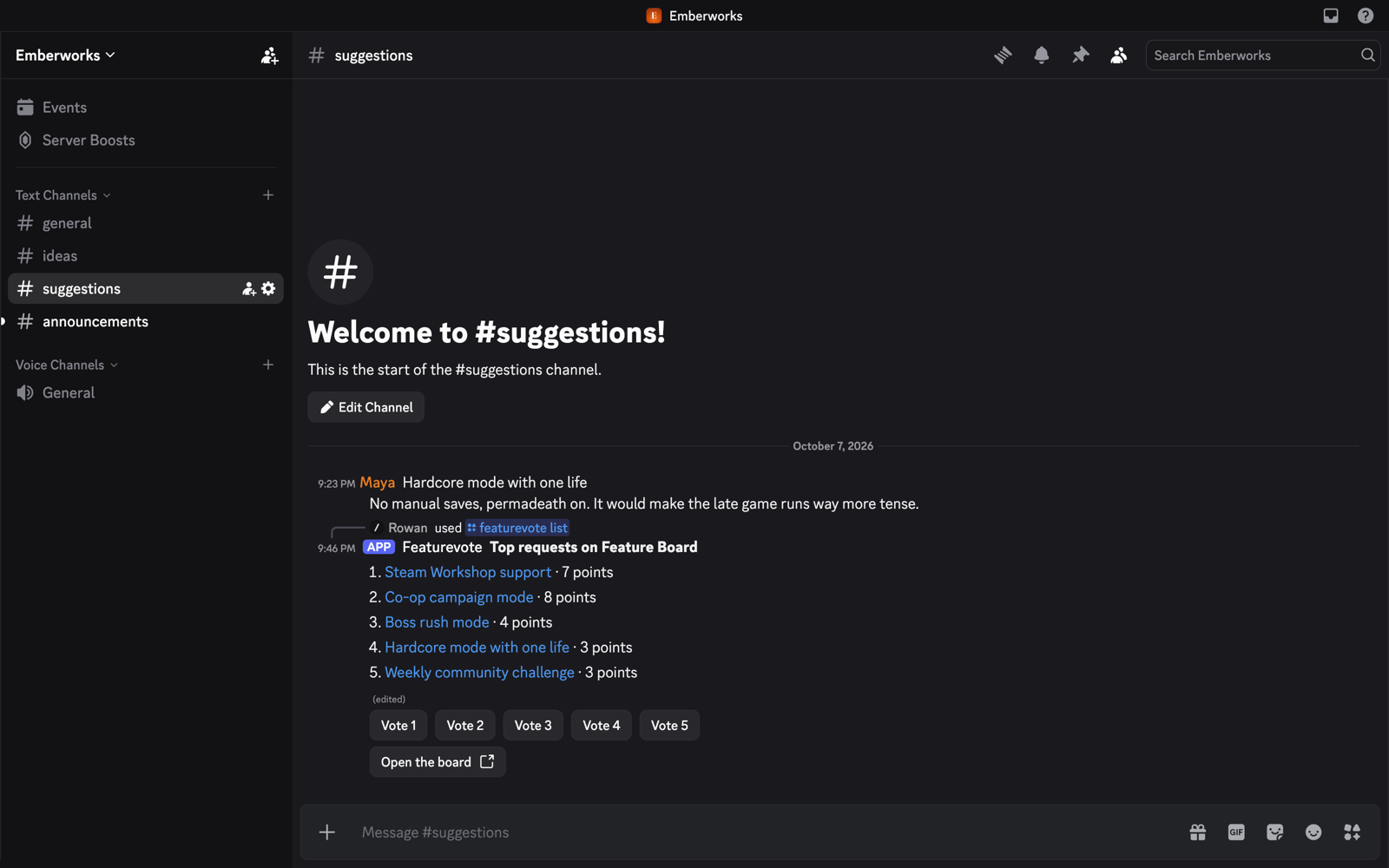
- Featurevote lets members log in with Discord and weights their votes by the roles you choose. In the server, members add a request with
/featurevote add, turn a chat message into a request, and vote with buttons on a posted list. Changelogs can post back to a channel. - Featurebase gives your Discord users a
/feedbackcommand to send feedback from Discord, and lets admins send a chat message to the board. New posts can go to a channel, and users can log in with Discord. Its help page doesn't say which plan includes this, and its pricing page lists integrations under Growth. - Canny lists Discord among its notification integrations.
- Nolt lists Slack and Discord integrations on every plan.
The alternatives, one by one
Featurevote
This is ours, so read it with that in mind.
Featurevote is a public board where people post requests and vote, with a roadmap and a changelog. Voting works without an account on every plan. For communities it connects to Discord and Patreon, so members log in with either one and their roles or tiers set how much a vote counts. You can also make a board members only, so only people in your server or your patrons take part.
The free plan has no limit on voters or on the requests and votes from your community. The limit is on your team's side, 15 active requests at a time, and a request stops counting once you mark it done or not planned. Growth is $9 a month billed yearly and removes that limit. Pro is $29 a month billed yearly. Discord and Patreon are on every plan, including free. Like Feature Upvote, each board has its own plan, so a second game is a second board.
Here is where it falls short of Feature Upvote. There is no SAML single sign-on, no Jira integration and no custom domain for the board, and the Featurevote branding stays on the board on every plan. How a Discord server runs a board day to day is in Discord feature voting, and the setup for studios is on the game developers page.
Fider
Fider is open source under the AGPL license, and the project is actively maintained. You can run it on your own server for free, or use the hosted version. The hosted free plan has a fair use limit of 250 feedback items, with no limit on users or votes. Pro is $25 a month, billed month to month, and adds content moderation, unlimited items and search engine indexing. Fider's own site names game developers among the teams it suits.
It fits a team that wants a simple board at no cost, or wants to host its own data.
Featurebase
Featurebase has grown into a support suite, with a help desk, live chat and an AI agent next to its feedback boards. The free plan has one admin seat, one feedback board and one roadmap, with unlimited end users and feedback. Paid plans are priced per seat, from $29 a seat a month billed yearly, plus a fee for each AI resolution.
It fits a team that wants support and feedback in one tool. One person can run a player board on the free plan, since end users and feedback are unlimited there.
Canny
Canny is one of the best known names in the category. It connects deeply to support and sales tools, and its AI feature, Autopilot, finds feedback in support conversations. The free plan covers 25 tracked users. A tracked user is anyone who posts, votes or comments, including feedback your team logs on their behalf. Pro starts at $79 a month billed yearly and rises as tracked users grow. Canny also offers special plans for high-volume consumer products and discounts for non-profits.
It fits a B2B company that wants feedback tied to revenue. A game with many voting players will pass 25 tracked users quickly, so ask Canny about its consumer plans first.
Nolt
Nolt is a simple board with flat pricing per board. Essential is $29 a month billed yearly, $348 a year, for one board. Pro is $69 a month billed yearly for five boards. Every plan includes unlimited users, content and admins. There is no free plan, but new boards get a 10-day trial of Pro. Essential includes single sign-on with JWT and the Discord integration. Pro adds Jira, Linear and Zapier, and SAML single sign-on is on Enterprise. Nolt lists player feedback among its use cases, offers hosting in Europe, has importers for most tools, and asks non-profits to get in touch about pricing.
It fits a studio that likes Feature Upvote's model of one price per board, with no counting of players, at a lower price. Nolt Pro's five boards cost less a year than two Feature Upvote boards on Indie.
When is Feature Upvote still the right choice?
Often. If the price per board isn't the problem, there are good reasons to stay.
- Every plan includes SAML single sign-on, a custom domain, private boards and the option to hide its branding.
- It connects to Jira, Linear, Zendesk, Microsoft Teams and Zapier, and has a REST API and an MCP server.
- It has a built-in spam filter, merges duplicates, and can show your board in other languages.
- It offers same day support on Indie and priority support on Standard.
- Studios like PLAION run their player feedback on it.
Everything above except priority support is on Indie, so a studio with one or two boards gets it for $49 a board a month, billed yearly. Moving a board also takes time, so switching makes most sense when the price or Discord is the actual problem.
Which one fits your board?
- You want what Feature Upvote does, at a lower price per board. Nolt.
- You want a free board and can live with a simple one, or want to host it yourself. Fider.
- You want support and feedback in one place. Featurebase.
- Your feedback comes from B2B customers and you want it tied to revenue. Canny.
- Your community lives in Discord or on Patreon, you want supporters' votes to count more, and you want Discord members to suggest and vote from the server. Featurevote.
- You want SAML single sign-on, a custom domain and Jira on the cheapest plan. Stay with Feature Upvote.
If what decides it is mainly how the bill behaves as you grow, free feature voting tools, plans and limits goes through the free plans in more detail.
Questions people ask
Is there a free alternative to Feature Upvote?
Yes. Featurevote, Fider, Featurebase and Canny all have free plans, and each one limits something different. Featurevote limits the requests your team has open, Fider limits items under fair use, Featurebase limits admin seats and boards, and Canny limits tracked users. Fider is also free to host yourself.
Can players vote without an account?
On Feature Upvote, yes, anyone can upvote. On Featurevote, yes, on every plan, unless you make the board members only or patrons only. How that works is on the no-login voting page.
Featurebase has a guest voting setting that lets visitors vote without signing in. Canny's help center says every user must be identified before they can post, vote or comment. The Nolt and Fider pages we read don't say, so check it on Nolt's trial or Fider's free plan before you move.
Can players vote from inside Discord?
On Featurevote, yes. A posted list of the top requests has a Vote button for each one, and the vote counts with the member's role weight. Featurebase has a /feedback command for sending feedback from Discord, and members can log in with Discord to vote on the board. Feature Upvote's Discord integration sends your team notifications of new suggestions and comments.
What happens to duplicate suggestions?
Feature Upvote merges duplicates and has a spam filter. On Featurevote, people see similar requests while they write a new one, and the ones that still slip through can be merged with their votes kept. More on that is on the duplicate detection page.
Can I take my suggestions with me?
Feature Upvote's help center covers exporting suggestions. Getting them into another tool depends on that tool. Nolt says it has importers for most tools, so ask the tool you are moving to before you start.
If something here has changed since October 2026, tell us and we will correct it.