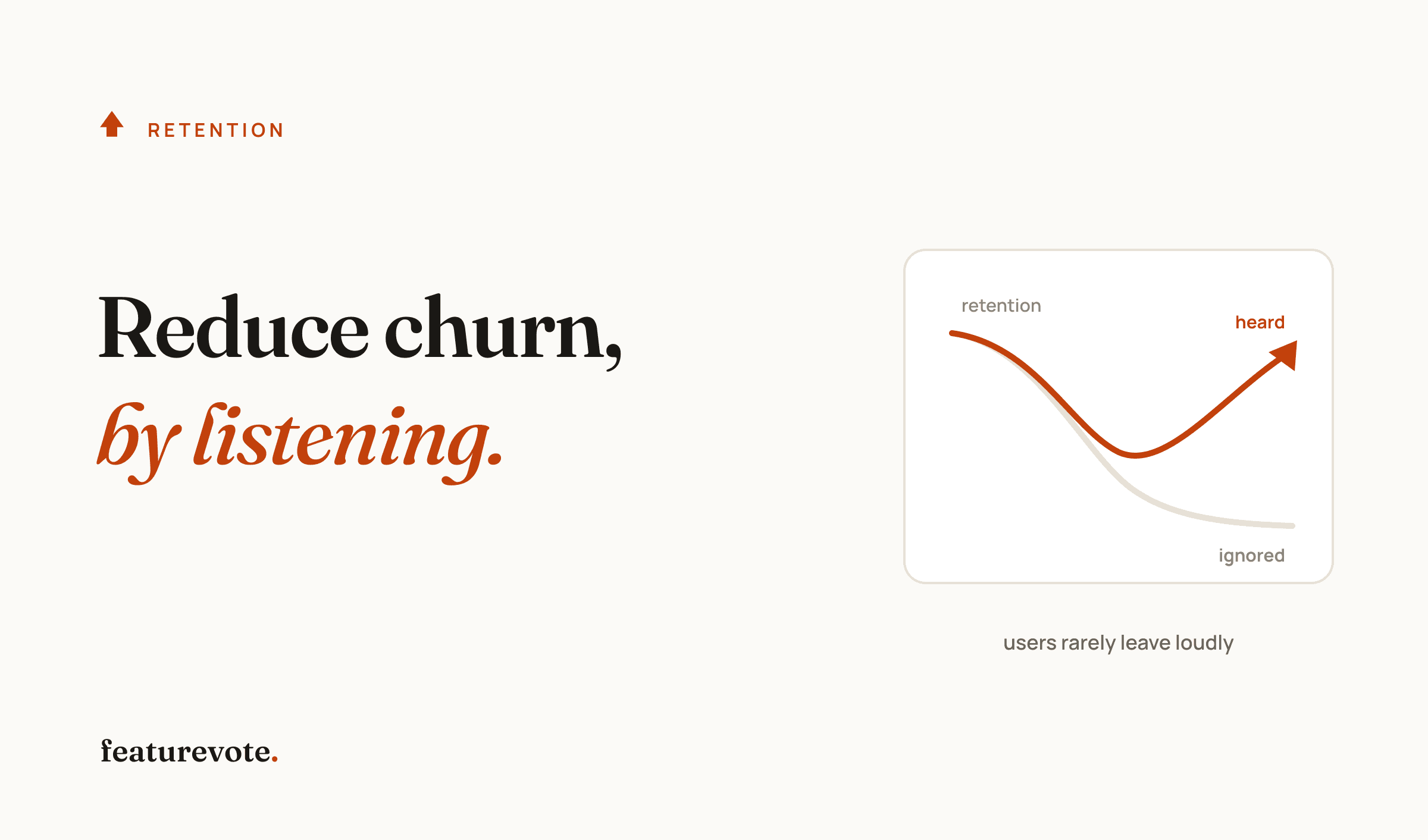
Churn is a silent killer for SaaS growth
You can acquire new users every day, but if they keep leaving, your growth graph stays flat. Reducing churn isn’t about clever pricing experiments or endless follow-up emails. It’s about building a feedback-driven system, supported by the right customer feedback software, that keeps users engaged and successful over time.
Here are eight ways to investigate churn and decide what to try.
1. Measure and Segment Your Churn the Right Way
You can’t fix what you can’t measure.
Start by defining churn for your product: is it subscription cancellations, or inactive accounts?
Track both customer churn (accounts lost) and revenue churn (MRR lost). Then segment by plan, company size, onboarding completion, or activity level. Strong customer feedback analytics and product usage data together reveal patterns like:
“Users who never invite teammates churn 3× more.”
The goal isn’t just to know your churn rate, it’s to understand which customers are leaving and why. That insight should feed directly into your feedback management software or product feedback platform so themes can be tracked and acted on.
2. Shorten Time-to-Value Through Better Onboarding
Most churn happens before users become truly active.
If people don’t see value fast, they leave. Onboarding is one of the strongest retention levers, especially when paired with an in-app feedback widget or product feedback tool that captures friction early.
Start by mapping your activation flow. What’s the exact moment users think, “This works”? That’s your Aha moment.
Concrete steps:
- Create guided onboarding checklists inside your product.
- Send automated, behavior-based emails to nudge inactive users.
- Show progress milestones (“3 of 5 steps complete — you’re almost there”).
- Embed a lightweight feedback widget after setup asking:
“What’s missing or confusing so far?”
Collecting feedback this early prevents silent drop-off and strengthens your customer feedback loop before frustration builds.
3. Use a Public (or Semi-Public) Feedback Board
Transparency is one of the most underrated churn-reduction strategies.
When users feel ignored, they disengage. A public feedback board or feature request board turns passive frustration into active participation.
Here’s how:
- Add a “Suggest a feature” link in your app, help center, or emails.
- Let users submit ideas through your feature request software and upvote others.
- Display statuses like “Planned”, “In progress”, and “Done”.
- When you ship something, reference the original request in your product changelog.
This visible feature request management process builds trust. Even if a feature isn’t prioritized immediately, customers feel heard.
A public or private feedback board also makes feature request tracking and feature prioritisation far easier for product teams.
Try Featurevote for free
Collect, prioritize, and communicate product feedback in one place.
4. Monitor Behavioral Signals and Re-Engage Early
By the time someone cancels, it’s usually too late.
Instead, monitor leading indicators:
- Logins dropping week-to-week
- Key features no longer used
- Teams shrinking in seat count
Proactively re-engage users with contextual messages:
“We noticed you haven’t used X feature lately, is something unclear or missing?”
Link directly to your customer feedback portal or feedback board so users can explain what’s wrong. Turning disengagement into dialogue can prevent churn before it happens.
5. Use Surveys, NPS, and Exit Questionnaires Strategically
Surveys aren’t vanity metrics, they’re early warning systems.
Use NPS to track loyalty, CSAT after interactions, and short exit surveys when someone cancels.
Ask one focused question:
“What made you decide to leave?”
Categorize responses: pricing, missing features, onboarding gaps, integrations, etc. Feed recurring themes into your idea management software or feature request software for startups and SaaS teams.
If 20% mention missing integrations, create a post on your public feedback board titled:
“Most requested integrations”
Let customers vote. You’ve just transformed churn data into engagement, and strengthened your product feedback analytics process.
6. Build Continuous Engagement and Deliver Value
Churn isn’t always caused by frustration, sometimes it’s caused by silence. When users stop seeing progress, they drift away.
Combat this with structured communication:
- Maintain a consistent product changelog
- Use changelog software to announce releases clearly
- Send monthly updates: “Here’s what’s new and what’s next”
- Share upcoming plans via your roadmap and changelog page
Well-structured release notes and thoughtful product updates don’t just inform, they reinforce that the product is evolving based on user input.
Each update is an opportunity to announce product updates, highlight improvements driven by feedback, and strengthen retention.
Transparency isn’t marketing fluff, it’s retention strategy.
7. Prevent Involuntary Churn (Payment and Inactivity)
Not all churn is voluntary.
Check how many cancellations follow failed payments or expired cards.
To reduce involuntary churn:
- Use automated dunning emails and retry logic
- Send card expiration reminders
- Provide easy “Update payment info” access
For inactivity, re-engage early:
“We noticed you haven’t logged in for a while, anything we can improve?”
Include a link to your customer feedback portal or product feedback board to reopen communication.
8. Act on Feedback and Close the Loop
Review the feedback, decide what to address, and tell customers what changed.
Establish a simple system:
- Collect feedback from your board, surveys, support, and in-app tools.
- Tag and organize it inside your feedback management software.
- Review top-voted items monthly.
- Share progress through your product changelog, release notes tool, or update email.
When you ship something, reference the original request. That’s how you close the feedback loop.
Closing the loop proves you listen. When customers see their ideas turn into features, loyalty grows, even if every request isn’t immediately built.
It’s not about delivering every suggestion. It’s about showing momentum, visibility, and intent.
Final Thoughts
Reducing churn isn’t a single tactic. It’s a system.
Consider:
- A structured feature request management process
- A visible public roadmap tool
- A transparent product changelog
- Strong customer feedback analytics
- And consistent follow-through
Measure whether the changes you make affect retention. Feedback can help explain the result.