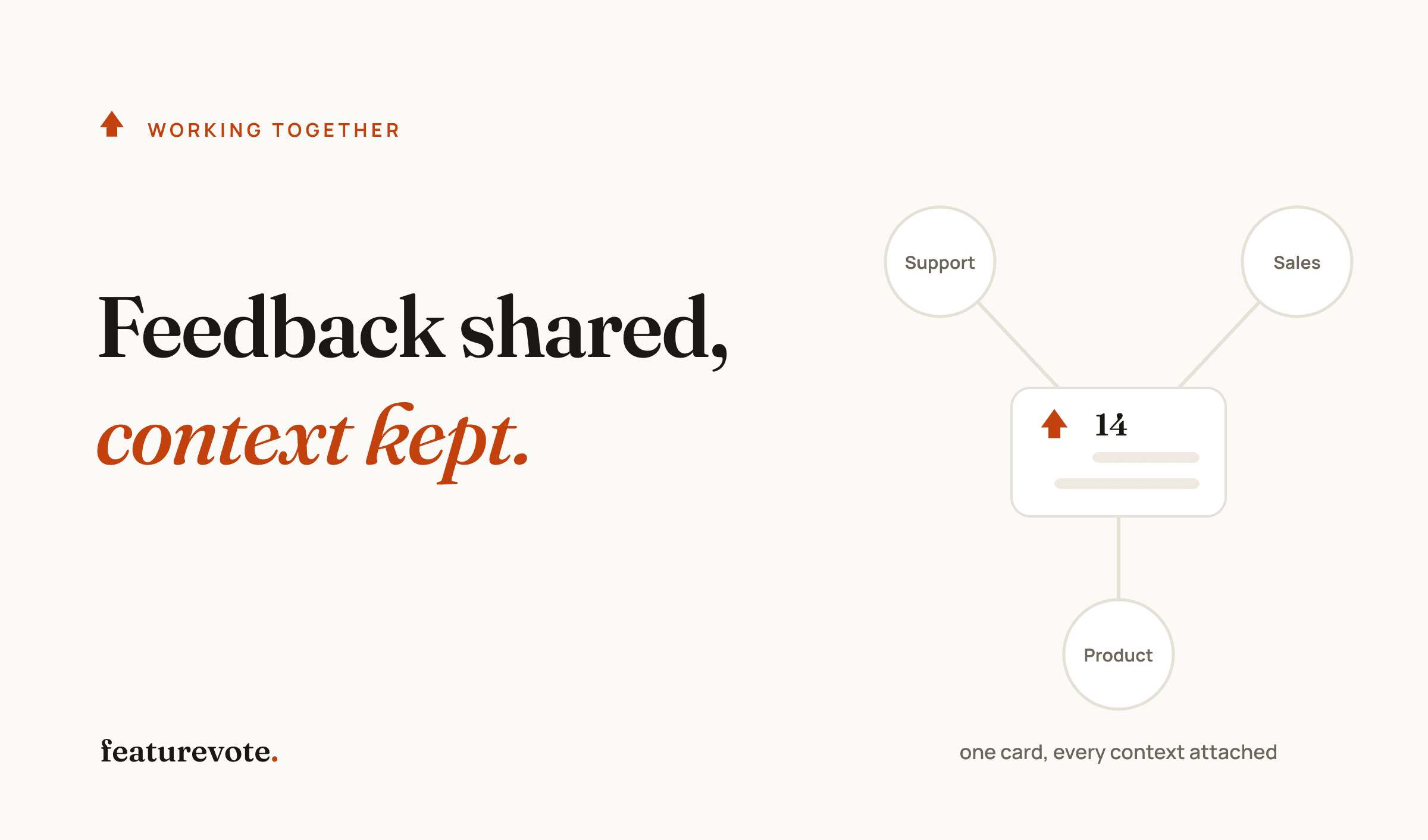
Why Product Feedback Often Gets Lost in Translation
Product feedback is one of your most valuable growth signals, but only if it survives the internal relay race from user to product team. In many SaaS companies, feedback arrives in fragmented snippets: a message in a support ticket, a note from a sales call, or a comment buried in a CRM field.
Without a proper product feedback platform or customer feedback software, these insights often lose context before they reach the product team. What began as clear user insight turns into vague summaries, and the nuance that made the feedback valuable disappears.
This disconnect isn’t just inefficient, it’s risky. Without structured feedback management software or a shared product feedback board, teams end up building the wrong things, answering the same feature questions repeatedly, or missing critical signals that could reduce churn and improve retention.
Let’s look at why context gets lost, and how the right user feedback tool can prevent it.
The Three Main Reasons Context Gets Lost
1. Feedback is routed manually and inconsistently
Customer-facing teams like support or sales collect feedback every day, but how it gets passed on varies widely.
One rep logs a note in Intercom, another posts in Slack, and someone else tracks requests in a spreadsheet. Without a centralized feature request tracker or feedback portal, valuable insights remain scattered across tools.
When teams rely on manual processes instead of a shared feature request management system, the signal becomes unreliable and hard to prioritize.
2. Feedback lacks user voice and specificity
When a sales note simply says “Customer wants better reporting” it’s unclear what “better” actually means.
- Which user asked for it?
- What problem are they trying to solve?
- What workflow is blocked?
Without the customer’s own words or a clear use case, product teams are left guessing. A good product feedback tool preserves the original message so teams understand both the what and the why behind the request.
3. There’s no closed loop or central view
Even when teams collect feedback well, it often lives in silos. Product managers might track ideas in Notion. Customer success keeps its own notes. Marketing rarely sees any of it. Without a shared customer feedback portal or feedback board, the insights never reach the roadmap.
As a result:
- Feedback never informs the product roadmap software
- Teams lack visibility into requests
- Customers never hear what happened to their suggestions
And the customer feedback loop remains incomplete.
A Better Way to Handle Product Feedback: Centralized, Contextual, and Shared
Centralize product feedback in one place
The first step is simple: bring all feedback into a shared system.
A centralized feature request board or public feedback board allows both customers and internal teams to submit requests, comment, and vote. Instead of digging through Slack threads or emails, teams can rely on a structured feedback management software to collect insights in one place.
By centralizing feedback, you create a single source of truth that everyone, support, sales, product, and marketing, can access.
Keep the user’s original voice intact
Whenever possible, feedback should be recorded using the customer’s actual words.
If support receives feedback through a ticket or chat, they should copy it directly into the product feedback platform rather than paraphrasing it.
With Featurevote, teams can:
- Attribute requests to specific customers
- Preserve the original feedback
- Add internal context through private notes
This ensures product managers understand the real problem behind each request.
Link feedback to specific accounts, personas, or plans
Not all feedback carries the same weight. A request from a high-value enterprise customer may influence prioritization differently than one from a free trial user.
A structured feature prioritisation tool or product feedback analytics system connects requests to customer data, making it easier to understand:
- Which features are blocking deals
- Which segments request certain improvements
- Where the highest impact opportunities exist
This makes prioritizing feature requests far more strategic.
Encourage inter-team collaboration on feedback
Different teams hear different types of feedback:
- Sales hears about missing features during deals
- Support hears daily usability issues
- Customer success hears long-term product gaps
When all feedback lives inside a shared product feedback board, every team gains visibility into what users need most. Teams can follow requests, discuss them internally, and collaborate before anything reaches the roadmap. This creates a clearer signal for product teams and improves cross-team alignment.
What Happens When You Get This Right
When product feedback flows through a structured feedback portal, the impact is immediate:
- Product teams make faster decisions based on real customer signals
- Support stops answering the same “Do you have this feature?” question repeatedly
- Sales gains visibility into what’s planned on the public roadmap tool
- Customers can track requests and receive product updates
- The roadmap reflects real demand instead of internal assumptions
In short, stop guessing and start building what users actually want.
Closing the Feedback Loop Is the Final (Critical) Step
Feedback isn’t complete until it’s acknowledged. Customers, and internal teams, need to know what happened to their suggestions.nWhether a feature request is accepted, declined, or shipped, closing the customer feedback loop builds trust and encourages more users to share feedback.
With the right changelog software and release notes tool, teams can notify contributors when requests move forward, publish product changelog updates, and announce new features and improvements
This turns feedback from a one-way submission into an ongoing conversation.
Product Feedback is a Team Sport
Your product feedback platform should make feedback:
- Easy to submit
- Easy to find
- Rich with context
- Shared across teams
- Connected to your roadmap and product updates
If your feedback still lives in Slack threads, CRM notes, or scattered spreadsheets, it may be time to move to a real feature request software built for SaaS teams.