Stop guessing what your users want. Let them tell you — and show them you’re listening.
The user simply stops logging in, grows frustrated over time, and quietly cancels their subscription. No warning. No chance for you to step in.
But when users can submit feature requests, vote on ideas, and feel heard, that silence breaks. You build trust. And more importantly — you build the right product.
A real feature request system isn’t a nice-to-have. It’s the difference between building for assumptions vs. building with your users.
Why You Need a Dedicated Feature Request System
If you’re still handling feature requests via support tickets, sales notes, or Slack messages, you’re missing the bigger picture. That kind of feedback is fragmented, biased, and nearly impossible to act on at scale.
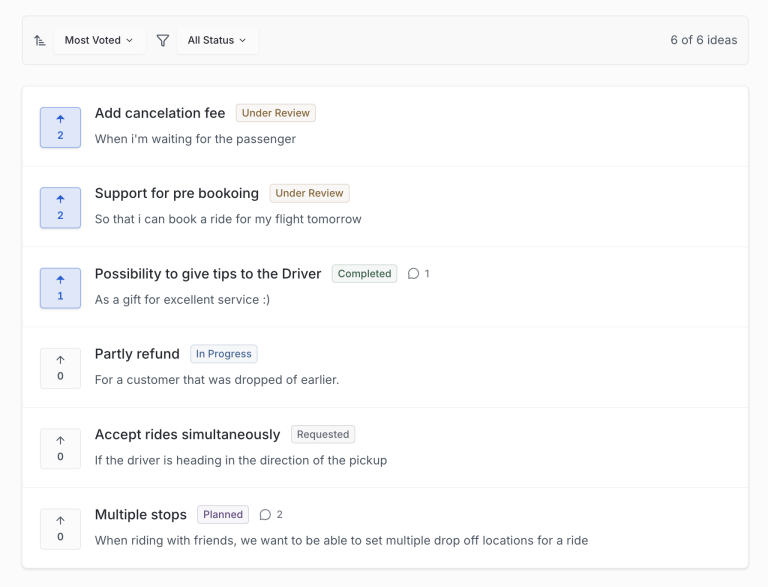
With a centralized feature request board, your users can:
- Submit their own ideas
- Upvote others’ suggestions
- Add real-world context in comments
This gives you a clear, prioritized, and user-driven product backlog — without all the noise. That is the job of a feature request tool.
Ask What Customers Need
By the time a customer cancels, it’s usually too late.
But when you give them an outlet to share feedback and ideas, you open a dialogue. You show that you’re listening. You give them a reason to stay engaged.
Customers who feel heard:
- Are more likely to stay
- Are more likely to advocate for you
- Are more likely to contribute product ideas that actually help
Reduce Guesswork — and Internal Debates
Product prioritization can be painful. Without data, every team has opinions — and meetings become endless cycles of debate.
A live feature board on a feature voting tool gives you immediate, democratic input from the people who matter most: your users.
It saves time, removes friction, and gives your product team a clearer signal about where to focus next.
Read Feedback Alongside Your Team’s Context
Sales can explain which requests come up during buying decisions.
Support can explain where customers get stuck.
Leadership will have their own vision and might have unconscious bias.
But users vote differently.
An open feature board helps you cut through internal bias and base your roadmap on real, measurable demand.
Fewer Support Tickets, Smarter Conversations
Tired of answering the same feature questions over and over?
With a public roadmap and feature board:
- Support can link directly to existing requests
- Users can see what’s in progress or already built
- You reduce duplicate tickets and increase transparency
Smart Places to Share Your Feature Board
Make it easy for users to find and engage with your board:
- Inside your app: Add a link in your main nav or account settings
- In support email signatures: A great follow-up for “Thanks, anything else?”
- In onboarding & follow-ups: Catch requests while interest is highest
- Post-resolution support emails: Let happy users suggest what’s next
Close the Loop and Build Loyalty
Feedback isn’t a black hole — but it can feel that way if users never hear back.
A proper feature request workflow should include:
- Automatic status updates when something is planned or released
- The ability to ask clarifying questions in public comments
- Invitations to betas or early access for engaged users
Tell contributors what you decided, including when you won’t build a request.
You reduce churn. And you turn product development into a shared journey — not a guessing game.